
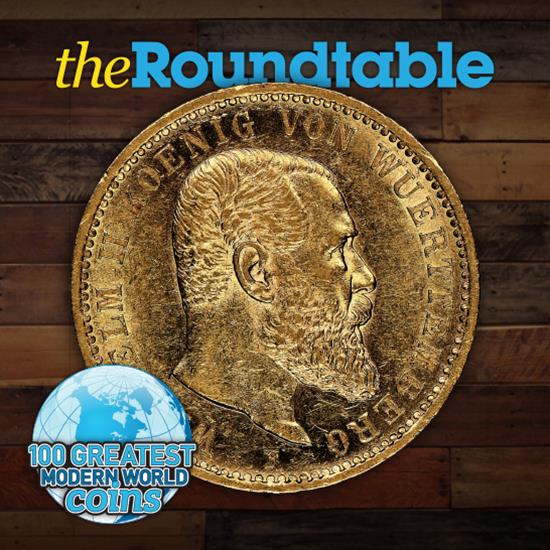
An empire established, a unified federation under one rule, and the ability to maintain individual sovereignty is the reason we are able to talk about the coin today as presented by Whitman Publishing’s 100 Greatest Modern World Coins. With help as always from authors Charles Morgan and Hubert Walker, they will take us through this rarity from across the globe and how it came to be.
#46 - Württemberg 1913-F Gold 20 Marks, Proof
Founded in 1871, the German Empire brought together the German states under one ruler (emperor or kaiser), Prussian King Wilhelm. All the states (or individual kingdoms and free cities) maintained their own sovereignty but recognized the kaiser in Berlin. When the Imperial Coinage Acts of 1871 and 1873 were passed, they did not recognize or prioritize the establishment of a central mint, leaving the individual German states the opportunity to mint their own coinage. One of those states was Württemberg.
The Kingdom of Württemberg was founded in 1806 as Elector of the Holy Roman Empire Frederick II made himself the king. Frederick’s grandson, Wilhem II, eventually became king in 1891 and reigned until 1918 when he abdicated the throne due to Germany’s defeat in the First World War. While his reign would end, he was a popular leader who progressed democracy within the state. Soon after, the establishment of the Weimar Republic occurred after the German Revolution in 1918-1919. The kingdom transformed into the Free People’s State of Württemberg. Wilhelm II would pass in 1921 with no heirs.
One of the coins minted under Wilhem’s rule in Württemberg was the 1913-F Proof Gold 20 Marks. Its design on the reverse featured the coat of arms which depicts the German imperial eagle with a shield on its breast. Even more so, the shield on the eagle depicts another eagle and the coat of arms, and again, that eagle bears a shield that features an eagle. This continuing design element was extremely unique.
The F mintmark on the obverse along with a young effigy of King Wilhem II stands for the Freudenstadt Mint. It was in Stuttgart, which is the largest city in Württemberg. What makes the coin a rarity is that most of the 1913 issues were melted down. It is unknown how many Proofs were produced, so its value is quite high. In fact, NGC valued it at $95,000 in 2020.