
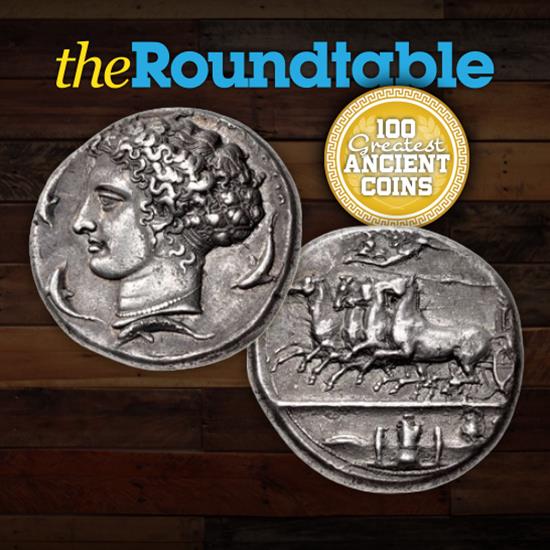
We continue our blog series covering Whitman Publishing’s 100 Greatest Ancient Coins today with a high-ranking coin that not only comes from a master engraver but is part of the highly detailed and highly sought after decadrachms. Author Harlan J. Berk will guide us along as usual as we remind you that this top 100 list features coins from the earliest onward despite their ranking.
#6 – Kimon Decadrachm (Sicily – 415 BC)
Eventually growing into a wealthy and powerful settlement after being established by the Corinthians in eighth century BC, the city of Syracuse expanded onto the larger island of Sicily within 100 years. They founded the colonies of their own at Akrai, Kasmenai, and Camarina. The coinage of Syracuse included silver tetradrachms and decadrachms that featured the head of Arethusa (nymph) surrounded by dolphins.
Issued around 415 BC, the first decadrachms from master engraver Kimon were struck from just three obverse dies and 12 reverse dies. Depicting a quadriga in full gallop with a flying Nike (personification of victory) above, the obverse also showcases a shield, spear, body armor, a Phrygian helmet, and the Greek letters spelling ATHEL just below the exergue line, or small space below the main design. The weaponry featured is meant to illustrate its capture when the Athenians invaded Sicily and that it was awarded as prizes in the athletic games held.
The reverse of the decadrachm depicts Arethusa wearing an ampyx (accessory used to pin hair back) and a pearl necklace. Four dolphins are seen surrounding her with the name of the city inscribed along the outer edge just behind her head. Berk points out that of the 12 reverse dies used, some are unsigned while others can be seen signed two or three times.