
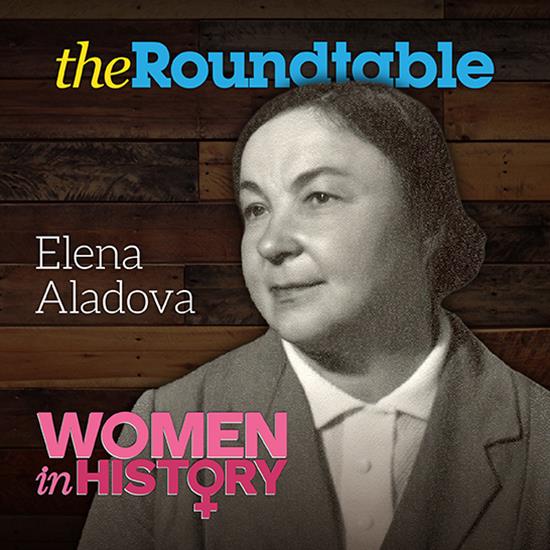
A "relatively unknown figure" who made a major impact is at the forefront of our blog series following along with Whitman Publishing's 100 Greatest Women on Coins. Author Ron Guth takes us through a specific time of her life as war tore through her country and more specifically, the art world in which she was heavily revered.
#97 – Elena Aladova
In 1941, the State Art Gallery in Belarus featured more than 2,700 pieces. This included French tapestries, Russian paintings, religious artwork, furniture, porcelain, handmade woolen bedspreads, and more. However, the catalog of the collection would never be completed before the war and the Nazi invasion. The collection did not survive as many went to Germany, others disappeared, and some destroyed.
Later on in 1944, the staff at the museum, including Elena Aladova, attempted to rebuild the collection from memory, but only a small fraction of it was ever restored. Elena was a major factor in the pieces that were recovered, and by 1946, the collection grew to 300. She would work with Mikhail Baklanov, an architect, to create the building needed to house the growing works. It is now known as the National Art Museum. When it was dedicated in 1957, the collection grew to the size it was before the war. The museum would hold an exhibition in 2007 to honor the 100th anniversary of Elena's birth and include the important contributions made by her.
In 2007, the Mint of Poland was commissioned by Belarus to issue a commemorative silver coin featuring Elena on the reverse. The obverse shows a depiction of the National Art Museum of Belarus along with the arms of the Republic of Belarus. .
It is easy to come by a 2007 Belarus rouble, according to Guth, despite its small mintage of 4,000.