
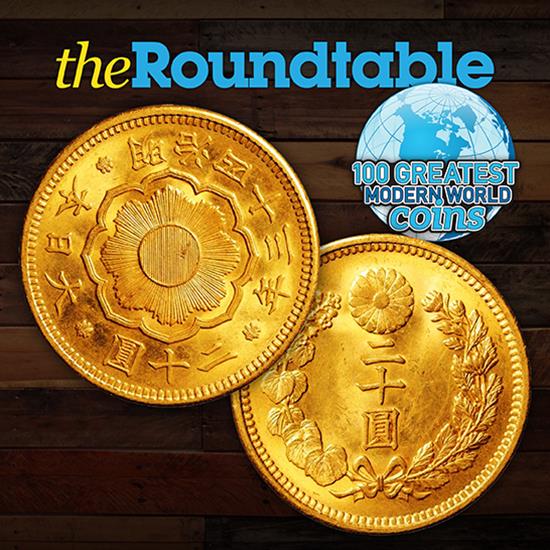
A rare issue during a reformation period is in the spotlight as we continue our blog series following along with Whitman Publishing’s 100 Greatest Modern World Coins. Authors Charles Morgan and Hubert Walker will guide us through the makings of the rarity as well as the timing of it.
#34 – Japan 1903 Meiji Gold 20 Yen
When Mutsohito, or Emperor Meiji, took the throne in early 1867 as a young teenager, no one expected him to be one of the most significant rulers in Asian history. During his reign, the country of Japan was forever changed as its dated feudal system was eventually replaced by a new imperial system. The new system gave the emperor ruling authority but also gave way for the creation of bicameral legislature (or legislature with two houses/chambers) and an independent judiciary.
What is referred to as the Meiji Restoration, the system emulated European standards. Education became a priority as well as industry, infrastructure, militarization, trade expansion, and foreign influence. Japan’s workforce was restored and brought into the modern world due to the emphasis on education and technology. While the country’s regional power increased, other major nations took notice, including China and Russia. The Japanese military would be tested because of this, but the strengthening nation would dish out suffering defeats of their rivals.
Calling back to the 20-yen gold coin series that began in 1897 during the Meiji Restoration, the 1903 issue is a major rarity. Japan would launch a new weight of the 20-yen, switching from 33.333 grams to 16.666 grams. An initial mintage of the new 20-yen was 1,861,000 pieces, but it would quickly halt production and not continue again until 1904. The Osaka Mint would then strike over 2.7 million gold coins. However, it was found that an unknown amount was struck the year before (1903), making it a modern rarity.