
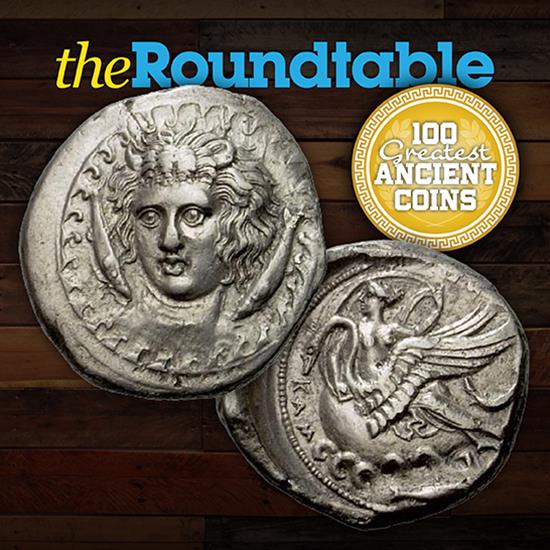
A city that was taken and retrieved in the throes of war and expansion is at the forefront of our blog series this go round talking about Whitman Publishing's 100 Greatest Ancient Coins. Author Harlan J. Berk takes us through the many wins and defeats the city endured while homing in on the rarity that came from the area amongst the chaos. Our coin today is specific to its creation year, something that is not always able to be focused on during this series' journey. As a reminder, this top 100 list features coins from the earliest onward despite their ranking.
#24 – Camarina Didrachm (Sicily – 410 BC)
As part of the expansion of Syracuse in 598 BC, the city of Camarina was inhabited due to its location between the Hipparis and Oanic rivers. The city previously did not have a seaport until the mouth of the Hipparis River was widened to welcome ships in. As the years moved on, Camarina grew in influence, which became a problem for them and those rivals from a distance. In 553, the city rebelled against Syracusan authority, but the army of Camarina struggled against the giant and were defeated. All those who inhabited the city were exiled.
The following year in 552 BC, Syracuse brought in new colonists with the purpose of growing the population like it was. Soon, it once again began to thrive until, much like the past, war would throw the thriving city by two rivers into chaos as Syracuse would lose it to a neighboring enemy, Gela. It took until 485 for Syracuse to gain control of Camarina once again, but it was depopulated for the second time. In 461, new settlers came in, many of which were from Gela. It was not until 258 that the city would again be thrust into the disaster of war. However, this time, it would be destroyed as the result of the First Punic War between Rome and Carthage.
Despite its tumultuous existence, Camarina did produce coins of their own. Specifically, the Camarina Didrachm from 410 BC. The obverse would depict the head of the river god, Hipparis, with horns on his head and long hair cascading down. Two fish (mullets) are seen on either side of his head which was indicative of the freshwater lake the fish resided in. The artist's signature (Euai) appears on the neck of Hipparis. The reverse features the nymph Camarina for whom the city was named after. She is seen on a swan for her veil blowing in the winch while the fish below are in the water.
What makes the design of this fifth century coin unique was its classical influence. At the time, art was starting to feature more complex designs with more featured elements and storybook details. This made the pieces more dimensional but also more emotional. According to Berk, there are fewer than 13 of these coins known to exist. All but one coin is from the same pair of dies.