
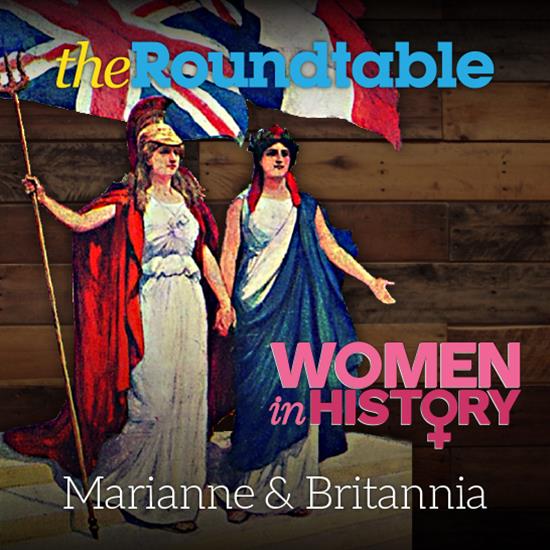
We in the United States are very aware what Liberty means in the landscape of numismatics. She is a figure that has been used throughout U.S. coinage and has taken shape in many different forms and versions. We also know that other countries have their own version of Liberty, two of which we will focus on next in our blog series following along with Whitman Publishing’s 100 Greatest Women on Coins. Author Ron Guth will help us with their stories.
#25 – Britannia and Marianne
Just like Liberty, Britannia and Marianne are representative of their countries, Great Britain and France. The female figures appear on coins throughout their respective histories, symbolizing very similar yet slightly different ideals.
The history of Britannia is more known than Marianne. In Great Britain, Britannia represents the people of Britain and is used to complement the monarchy. She first appeared on pattern coinage all the way back to 1665 and made her grand appearance on circulation coinage in 1672. Copper coins would feature her image in the 17th century through the 19th century and in 1895, she would show up on the British trade dollar. Today, she is still used on gold and silver bullion coins.
Marianne’s beginnings came much later than her Britannia counterpart. In France, she represents liberty and republican ideals, shying away from the former kings. She did not make an appearance until the French Revolution when she was featured on a coin four years into the First Republic (1795). She donned the Phrygian cap, which symbolized freedom. However, her image was short lived as Napoleon would become First Consul, and all the coins would return to their male dominated state. A new female would appear in 1870 on coins, but Marianne would not make her return until 1898.
In 2004, Great Britain would issue a special coin that would feature both female figures in celebration of an alliance between the two. It was referred to as Entente Cordiale and occurred to counter Germany’s expansion during the Second World War. The 100th anniversary coin featured Britannia and Marianne upside down and right side up. Queen Elizabeth II appeared on the obverse. France would also issue silver coins and gold coins with an identical reverse. This was a rare occurrence symbolizing two nations on the same coin.
According to Guth, collecting the British and French coins celebrating the alliance in 2004 is easy. However, the French 2-euro gold coin is harder to find and much more expensive as its mintage was just 339.