
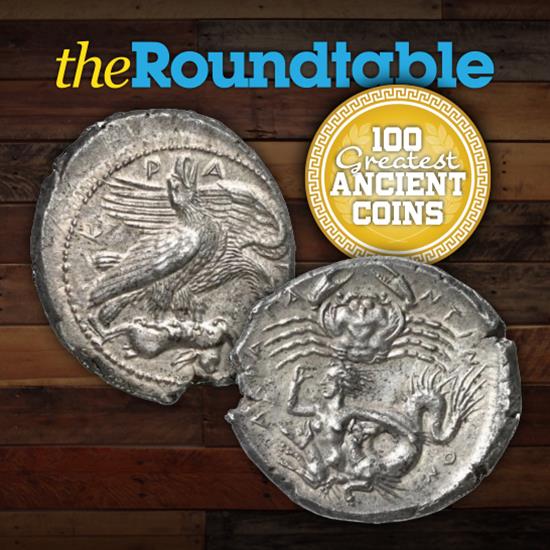
Perhaps one of the most beautiful designs so far will be covered today in our blog series following along with Whitman Publishing’s 100 Greatest Ancient Coins. Author Harlan J. Berk thoroughly speaks on the important design elements, something we will try to communicate with you as we continue this journey along with him. As a reminder, this top 100 list features coins from the earliest onward, meaning their rankings are out of order.
#21 – Acragas Skylla Tetradrachm (Sicily – 420 BC)
The second largest Greek city on the island, Acragas controlled rich agricultural land and was situated on the southern shore of Italy, a great established area for trading. However, despite its advantages, its major disadvantage was how close it was to territories ruled over by Carthage. This meant that every major battle pretty much guaranteed their involvement in the conflicts between Carthaginians and the Greeks.
In the years between 500 BC and 430 BC, coins of Acragas were expertly crafted by engravers, but the designs remained conservative, according to Berk. Around 430 BC, engravers would introduce a more classic design, ensuring that future designs would continue to transform based on innovative styles. This mindset certainly led the way for the Acragas Skylla Tetradrachm.
Struck around 420 BC, the obverse features two eagles, one with its head back screaming while the other bends down. Berk makes note of the intricately engraved feathers, stating that the “strong composition is beautifully balanced and executed.” The reverse is even more impressive, showcasing the crab, which is the traditional badge of the Greek city. Below the crab is the mythic creature, Skylla. With the upper body of a woman with two hounds on either side of her, she seems to also have the tail of a sea monster. The entire design is symbolic of what the sea means to Acragas with the artistry signaling the city’s wealth and refinement.
According to Berk, there are fewer than 20 of these tetradrachms recorded.