
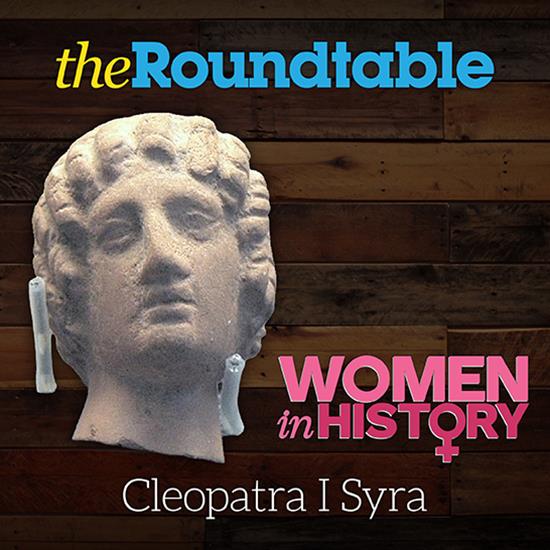
As we continue moving through Whitman Publishing’s 100 Greatest Women on Coins series today, we will find ourselves learning about yet another Cleopatra. However, according to author Ron Guth, this Cleopatra was the first. Let us learn more about her journey through this blog series and how she made an impact on coinage from the ancient world.
#55 – Queen Cleopatra I Syra
Born around 204 BC, Cleopatra I Syra was the first of all the Cleopatras from Egypt, some of which we have already covered in this series. What is interesting is that she is of no relation to those women from earlier times, and despite the numbering system being inconsistent when it comes to the lineage, Cleoptra I Syra is the first of the Egyptian queens. Her descendant, Cleopatra VII, was the last (#4 on the list).
One of three children, she was born to the king of the Seleucid Empire, Antiochus III, and his wife, Queen Laodice III. After the death of Alexander the Great, the empire was born and covered a large portion of Asia. Opposite the Seleucid Empire was the Ptolemaic Empire, which included most of the northeast Africa, which was where Egypt was located. This created conflict between the two, naturally. To quell the growing tension, Antiochus offered his daughter, Cleopatra, for marriage to Ptolemy V of Egypt. The wedding was held in Raphia in 193 BC, which was a neutral city between the two bordering empires. She was only 11 while Ptolemy was 17.
The two would go on to have three children: Cleopatra II, Ptolemy VI Philometer, and Ptolemy VIII Physcon. Cleopatra I Syra’s husband died in 180 BC, placing her as a co-ruler until her son was old enough to reign. She would end up passing away just four years later in 176 BC.
Appearing on several Ptolemaic coins, Guth reveals that the collecting difficulty is moderate. Bronze coins showing her as Isis (goddess of magic, motherhood, fertility, and kingship) are common and rather inexpensive. However, the gold coins she appears on are expensive. The gold octodrachms were struck in the name of Arsinoe II and attributed to Cleopatra I. Because they were struck over a long period of time, it is questioned whether they are depicting Cleopatra.