
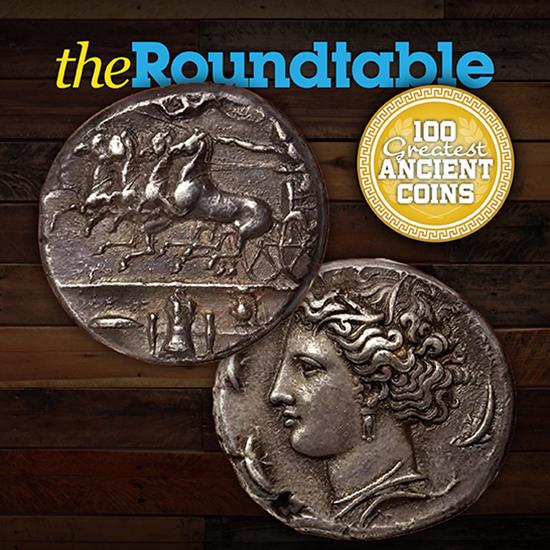
The last entry in our blog series covering Whitman Publishing’s 100 Greatest Ancient Coins highlighted a decadrachm, which as we now know are highly sought after when it comes to collecting numismatic coins. Today, we look at another engraver’s decadrachm that has landed in the top 10. With help from author Harlan J. Berk, we learn more about the artist’s portfolio and the characteristics that make him recognizable within his work. As always, we remind you that this top 100 list features coins from the earliest onward despite their ranking.
#3 – Euainetos Decadrachm (Sicily – 412-393 BC)
An engraver at the Siracuse mint, Euainetos was around at the same time during Kimon from our last blog focusing on his decadrachm. However, while Kimon only produced three obverse dies, Euainetos created 24. Despite his dies being unsigned, his work was undeniable and highly recognizable. According to Berk, his work is simple and realistic as well as proportionate as he spearheaded the modern art movement during his time. Berk classifies Euainetos’ work compared to Kimon as bolder and more self-assured.
On the decadrachm, the obverse features a racing quadriga with the goddess Nike flying overhead crowning the driver of the chariot. A shield, crested helmet, and a cuirass sit below the exergual line, or the small space below the main design. This is where Berk suggests that Euainetos’ engraving style is on full display as the elements are deeply cut and precise.
The reverse of the coin depicts the nymph Arethusa wearing a wreath in her hair, a pearl necklace, and earrings. While Berk reflects on Kimon’s work as bringing to life the sweetness of Arethusa’s face, he also suggests that Euainetos’ style shows her stronger and more mature. The four dolphins surround her as the name of the city is at the top right, and the name of the artist is below her.