
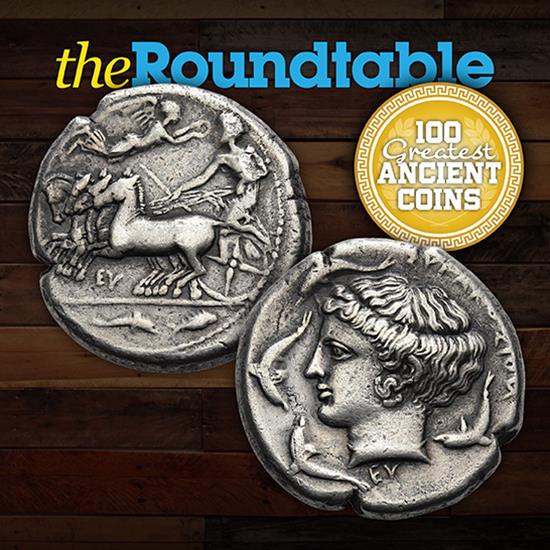
To sign or not to sign? That certainly is the question regarding our next coin dissection from the 100 Greatest Ancient Coins series published by Whitman Publishing. Author Harlan J. Berk takes us back to where it was rarer to see signed dies than to not see them. Our coin today does indeed have a signature, and in fact, comes from a region that produced mostly signed designs. Berk will take us through this entry which sits in the top 20. Reminder: this top 100 list features coins from the earliest onward despite their ranking.
#17 – Syracuse Tetradrachm (Greece – Circa 415-405 BC)
No matter the design, no matter the artistic style, die-engraver signatures did not appear on millions of Greek and Roman coins apart from a few. The reason it is not common for a signature to appear on the coins is because they were property of the state. Back then, only mint masters, rulers, civic magistrates, or moneyers (or authorized persons granted permission by the state or king) had the right to put their name or symbol on a coin. It is unknown if the signed coins held specific significance, but when they did appear, they were more than likely abbreviated and placed in modest areas on the obverse or reverse.
Other well-known rarities that featured a signature not from Italy or Sicily were the tetradrachm of Clazomenae and the tetradrachm of Rhodes. In certain cities from those countries, engraver-signed dies were more common. Other signed dies are found on the decadrachms and tetradrachms of Syracuse from 415-395 BC. There are 81 known signed dies using different combinations. Engravers among these dies include Eumenes, Sosion, Eukleidas, Eumenos, EV, Phrygillos, and more.