
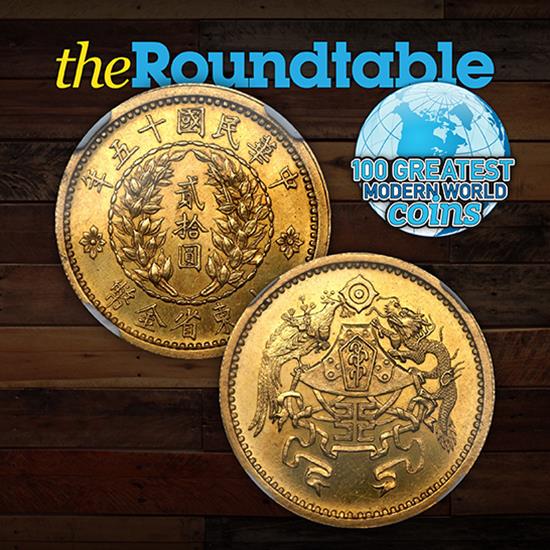
A design that sticks out during its production period, but a complete mystery otherwise is the center of our attention as we continue our blog series following along with Whitman Publishing's 100 Greatest Modern World Coins. Authors Charles Morgan and Hubert Walker take us through the design, its symbolism, and why the rare pattern coin is confusing to collectors.
#23 - China 1926 Shantung Dragon and Phoenix Gold 20 Dollars
The 1926 Shantung Dragon and Phoenix 20 Dollar Gold pattern coin from China features the 12-symbol national emblem on the obverse. A phoenix is on the left and a dragon to the right. While referred to a Dragon and Phoenix in Western culture, the phoenix is actually a fenghuang, a Chinese mythological creature. The anatomy of the fenghuang, celestially speaking, symbolizes a royal female mate to the dragon, which is a powerful figure in Chinese mythology.
What makes these figures on the pattern coin interesting, according to Morgan and Walker, is that China's last emperor was removed in 1911 and replaced by the Republic of China as the country wanted to modernize. Collaborators created the new design referencing the Twelve Ornaments, and it was produced in 1912 and later adopted in 1913. Other than this pattern coin, the design was used on a few different Chinese Republic coins, beginning with the 1923 dollar and then again on the 1926 10-cent and 20-cent coins, the Shantung Province 10-dollar pattern, and the 1926 pattern, and the 1927 Chang Tso-lin 50-yuan gold pattern.
Morgan and Walker note that beyond the design and the date, nothing is really known about the 1926 20-dollar gold pattern. It is believed that it was struck at the Tientsin Mint but was not used in circulation. The date lines up with the unstable rule of General Zhang Zongchang.
It is reported that there are approximately five to seven examples known. One was sold in a MS64 from NGC in a Heritage Auction in 2014 for US$176,250. It was part of a 400-coin collection that featured world and ancient coins.