
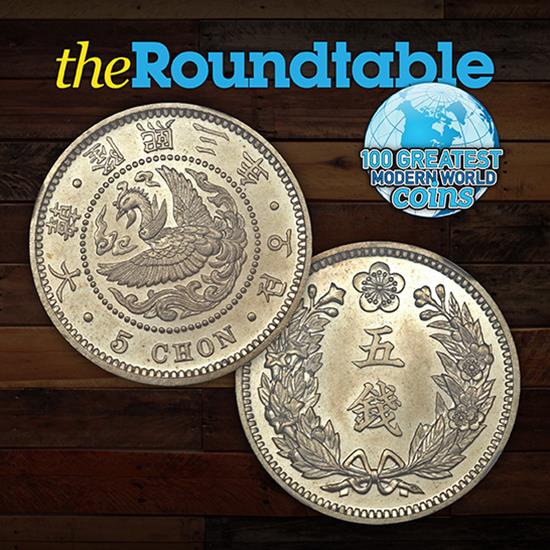
A coin struck during a transitional phase, and a period of modernization is the center of focus this time following along with Whitman Publishing's 100 Greatest Modern World Coins. Authors Charles Morgan and Hubert Walker steer us through a nation's major change through the first decade of the twentieth century and how their monetary system looked during it all.
#61 – Korea 1909 Yunghui Copper-Nickel 5 Chon
As the 19th century ended, the country of Korea was just starting to adhere to modern reforms, namely tackling its monetary system in 1882. It used cast money (or ancient and traditional Korean coins) for centuries. Their first exploration of what that could look like came in the form of three different denominations: 1, 2, and 3 chon (chon referring to a tenth of an ounce).
While the updates started, the efforts did not prove to be much of a success for Korea. That did not stop them from investing in expensive minting machinery from Germany and continuing to push the modernization of coinage. The next year, they produced another series of coins but struck in limited numbers. Those coins were struck in silver, copper, and brass.
The years following would continue coinage reforms, even as Korea was facing a major political firestorm. A peasant rebellion in 1894 would be the match that started a war between China and Japan. However, the Qing dynasty was no match for Japan's modern army and navy. With a victory for Japan, Korea would go on to declare itself an Empire. With this new title, they took on more radical reforms, falling under the influence of Japan and shaping those reforms to their political advantage.
That first decade in the 20th century would see the monetary system of Korea updated to make the yang a primary unit of currency. Denominations used were the 1, 2, and 5 fun and the quarter yang. Referring to the 1909 5 Chon, its mintage is unknown, but NGC has only certified seven total coins. Of the seven, five were circulated details grade that did not get assigned a numerical grade.